

When unfortunate word came down that Pharmakon had to drop off the weekday noise gig two days prior, I was struck by a bold idea. What if I still went to the show anyway?? I’ve somehow failed to catch Pharmakon live after all these years, but it’s nice to have goals to strive towards, and I was overdue for an evening of heavy noise abuse regardless. With an open mind towards homeopathic medicine, the proposition of a sonic colonic was particularly appealing this evening, as the sustained barometric pressure of the late summer had left our corporeal forms demoralized and weary.
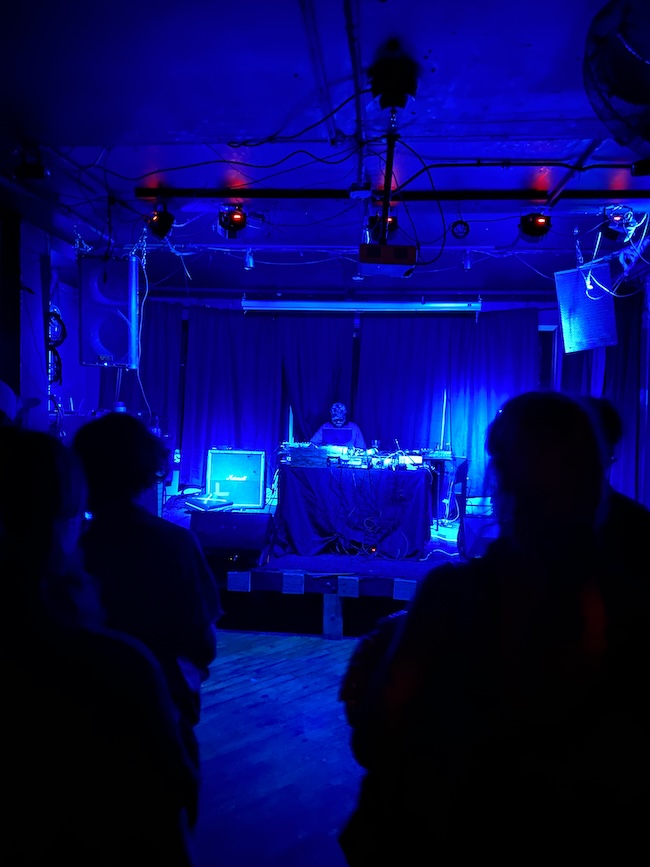
I met up with a fellow noise enthusiast – let’s say their name might rhyme with “Kill Face” – whose perspective I was eager to tap into, being woefully unfamiliar with the evening’s remaining performers. Through our pre-show conversation, I gleaned that opener Patrick Gallagher’s participation goes beyond performance – he’s one of those crucial behind-the-scenes guys who make things happen in a scene that has more than its share of unstable and unreliable personalities. He booked a show for the troublingly handsome Philly-via-Providence noise quartet Pool a few years ago that I really enjoyed, and with his own table arrangement of laptop, mixer and a spaghetti buffet of cords, I found his sounds to be the evening’s most engaging. Presenting like an orientation-fresh Ice Road Trucker in camo ballcap and collared shirt, Gallagher deftly pulled a variety of organic / inorganic confusion out of his laptop. Picture Aaron Dilloway painting with Tod Dockstader’s colors. Gallagher’s approach was patient yet persistent; he cycled textures in and out, favoring bewildering sounds over oppressive frequencies. I have no clue what he was actually doing, of course, and as my mind wandered to thoughts of what it’d be like if it became the norm to project the laptop screens of the live performances that utilized them, I realized that I actually prefer things the way they already are. I don’t think I’d want the advance notice that a DAW screen provides, and would rather be surprised by an abrupt cut or creeping tones entering the mix, especially if the sounds and textures are as freaky as Gallagher’s.
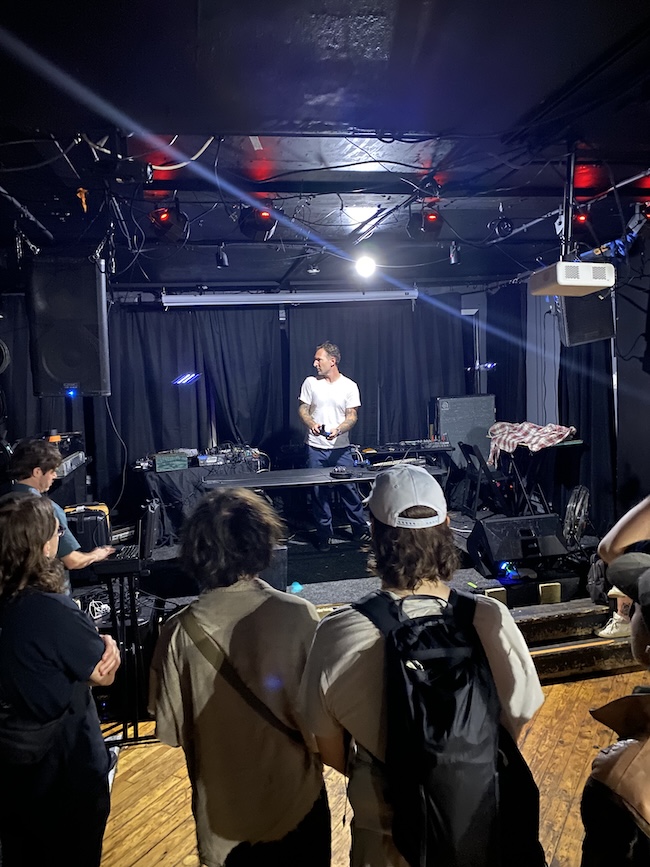
Up next was $5000 – an amusing moniker befitting an amusing performance. It’s the name that Zeno Ben-Amotz has been using for his solo work, though you might recognize his (quite recognizable) name from the amorphous Crazy Doberman ensemble. (This reminds me: I saw another Crazy Doberman alum, Drew Davis, perform a few weeks ago. His set, wherein he picked up various blow-able objects and blew them sequentially for about ten minutes, further enhanced my appreciation of what a weird ass anarchist-democracy that band must’ve been.) Ben-Amotz spent about as much time getting two little flying drones (physical drones, like ones sold at Best Buy or Wal-Mart) in working order as he did “playing” them, which loosened up the room’s atmosphere nicely. We were all rooting for him, particularly after one of his drones struck a PA speaker and tumbled to the ground with a jolt. Such was the nature of this performance: Ben-Amotz mic’d up two frisbee-sized drones, controlled the unwavering pitch of their buzzing engines through a mixer, and did his best to make sure they didn’t break. As a sonic experience, it wasn’t much, but as a performance, it was a delight. I personally find the concept of drones to be viscerally unpleasant, which was surely part of the point. Their imposing, amplified buzz had me full-body bristling, a timely reminder that we walk among people who actually like this sort of technology, delivered with the wink of the obvious “drone” pun, a dad-joke groaner to ensure no one was taking themselves too seriously. A simple but effective trick – let’s hope his next performance involves Flock cameras and a Bart Simpson slingshot.
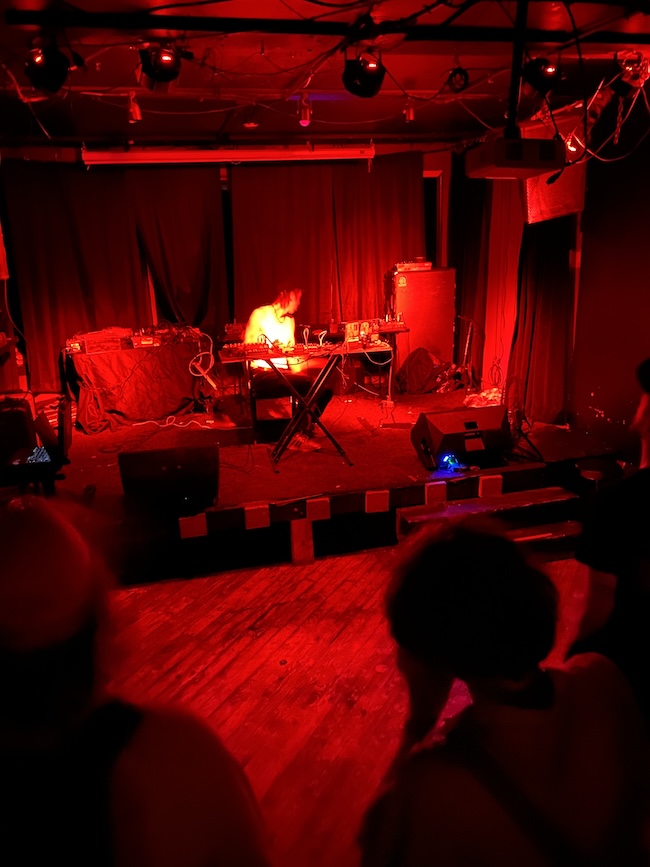
With drones powered off and fully secured, Jacob Winans assumed the center-stage table position in short order. He’s bounced around for gigs or temporary residence in noise-friendly enclaves like Western Mass, Brooklyn, and Japan, and faced the agreeable situation of a loosened-up noise crowd eager to receive his harsh abstractions. It was the first set of the night to really hone in on those painful higher frequencies, which he delivered in layers: sharp-snapping glitches; the missing tones of a tinnitus-riddled eardrum; ominous builds that cut to silence at the slap of a button. Like Gallagher, Winans opted for a seated position, but unlike Gallagher’s air traffic controller poise, Winans drifted into spells of thrusting, physically compelled by his cacophonous mix of analog and digital deconstructions. I was particularly compelled when intangible patterns emerged, with the unquantized feel of a knee nervously tapping or steam pinging through old pipes. If I came out to the gig hoping someone might drill a hole to connect the empty space between my ears, Winans said hold my beer.
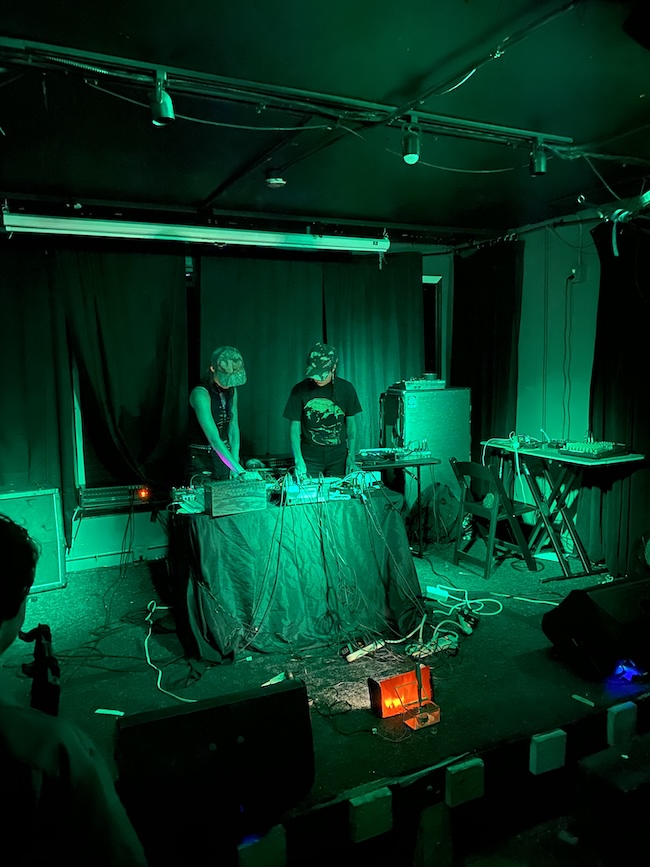
It was with a conflicting mix of sonic fatigue and weeknight-out merriment that I met Relay For Death. The duo of identical twin sisters Rachal and Roxann Spikula boasted the most decorated discography of the evening, having recorded for lauded scene lynchpins like Hanson, Helen Scarsdale Agency, and even RRR. Sporting camo trucker caps that might’ve come from the same country rest stop where Gallagher got his, the sisters divided their roles evenly, one operating a wooden box with metal accoutrements, the other handling the knob-twisting and level-adjusting. They delivered a punishing mid-range, winning the unspoken loudness competition that takes place at every noise show (with the exception of the noise shows with unspoken competitions to see who can be the quietest). Towers of noise crumbled over each other, tectonic plates crackling and snapping in sustained motion. The jet-engine blast led Winans and Gallagher to high-five each other at one point, front and center on the floor for Relay For Death, erupting with the goodwill seen in Van Halen fans when the band finally kicks into “Hot For Teacher”. Chalk it up to Relay For Death being the fourth consecutive noise act of the evening, but their set struck me as the least engaging – a harsh, unrelenting tumult that never aspired to be anything but. Appealing, but in a way that countless other noise acts are appealing. Maybe that’s just me, though: the crowd, consisting far more of friends and social acquaintances than segregated “fans”, seemed quite pleased by what they were witnessing. In such a community-driven, underground genre, it’s sometimes difficult to discern what the audience is revering most: the music, or the cult of personality that surrounds its maker. I suppose I could solve this problem by choosing to only listen to music made by repellent friendless loners, but where’s the fun in that?
Thoroughly cleansed by the would-be Pharmakon openers, I stepped outside to discover that the humidity had broken in the form of a massive storm during the show. Blacktop puddles and downed branches offered evidence of the sky’s violent eruption. It would’ve been a fitting backdrop for the show if the small club venue, Nikki Lopez, had any windows in its second-floor performance space. I found out the next day that another act followed Relay For Death to headline the gig: Housefire. The North Carolinian has a record advertised as “natriarchal psy-op trance”, and while I’m sad I missed it, there’s always next time. Maybe with Pharmakon?
 Back to top