

Consensus Madness Endeavors LP (Iron Lung)
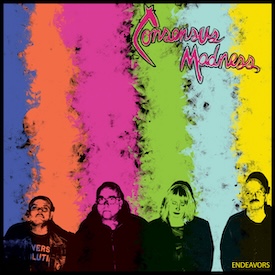 Consensus Madness picked the six sickliest Pantones they could find and rolled them down the cover of Endeavors, their full-length debut. Gross times call for gross colors! This Chicago group is in a pretty nice spot: seasoned punk-rock players in a fresh new band. The first-full-length excitement is audibly evident in these snappy, bratty songs, performed with the comfort and proficiency of hardcore elders. Chicago isn’t usually the first American city people turn to when they want some raw, sing-along punk, but Consensus Madness should turn a few heads with their no-frills approach, not unlike The Avengers tangled up with The Vicious. Sarah Ryczek’s vocal delivery is angry yet resigned – so it goes when you ponder the vast quantity of absolute morons that are wandering around out there all day every day. Tonally she reminds me a bit of Naked Aggression’s Kirsten Patches, though Ryczek has the benefit of a ripping trio behind her, featuring Jeff Rice of the legendary power-violence unit Ottawa in fact. If we can get more than a tape out of Cucuy, and coax Daddy’s Boy into an east coast tour, might it then be time to upgrade this fine city’s official hardcore rating from B+ to A-?
The Drin I Lost My Way For Centuries 2xLP (Feel It)
 Like any regional scene of note, there’s a bit of incestuous musical behavior going on in Cincinnati right now, what with players overlapping in various projects, writing the songs for some and following along in others (to say nothing of the proliferation of solo projects). Dylan McCartney plays in Crime Of Passing and The Serfs, but word on the street is that The Drin is his sweetest child. He’s certainly keeping it well fed – I Lost My Way For Centuries is abundant with the stormy, unresolved specter of rock n’ roll past. While the mood remains evasive and the tempos rarely exceed a lurching groove throughout the double album’s duration, McCartney and Co. pull all sorts of sonic ideas into their black hole, particularly those that jive with the dark-skied horizon they’re forever riding towards. Imagine if The Doors sounded as cool as you thought they did before you actually heard them, Rowland S. Howard in a period-accurate Neil Young costume (complete with prosthetic grey mutton chops), Psychic Ills relocated to a bayou houseboat, Bardo Pond covering Black Rebel Motorcycle Club during a power outage, Brain Records and SST Records melted together on the dashboard… there are enough diverging styles, sounds, and instruments (bouzouki: check!) across I Lost My Way to keep even the most fidgety listener hypnotized. Nineteen songs, poised to inspire nineteen Denis Johnson short stories.
Early Grave Violent Winter LP (General Speech)
 Early Grave extends their skeletal hands with a sinister prediction: it’s going to be a violent winter. The Philly trio have been blackening stages (read: floors) throughout the city since last year, and have followed their phenomenal debut EP with the fifteen track assault of Violent Grave. Like their debut EP, Early Grave take horror aesthetics and apply them to unrelenting hardcore-punk like black polish upon toenail. Occasional solos will point in the direction of Venom, Sarcofago and Mercyful Fate, but the rhythm section is consensually caged within hardcore-punk’s straightforward aggression. It results in songs that are easy to rage along with but probably kind of tricky to rehearse, based on the constant shifting between riffs, tempos and drum patterns. It’s downhill music at a dangerous grade, full of violent speed-wobbling and treacherous bails, made all the more intense by the drumming, verging on falling apart (that “Grim Monument” intro!) but nailing those air-tight fills every time. There’s evidence of Early Grave branching out from purely repulsive hardcore thrash here, what with gang-sung whoa-ohs (“Baby Blood”), the Dawn Of Humans-esque “Black Easter”, a variety of intricate guitar leads, and the atmospheric intro of album-closer “Fear Liath”, but it still welts you up like a whip. Need a handy tip for saving money on your heating bill this winter? Get some rats to chew through the wires in your electrical breaker and huddle over Violent Winter for warmth.
Gilla Band Pugnello LP (Rough Trade)
 “Noisy, no cracks, pops, or surface noise just some noise.” You know you’ve reached the next level of success when you’re getting loser-ass comments like that on the Discogs page for your new album on release day! Gilla Band have moved beyond the secretive realm of in-the-know hipster fans and, well, into the faceless masses of vinyl dweebs, and I’d say the larger audience is well-deserved. Their hybrid of spastic, noisy post-punk and cutting-edge techno procedures is intense and attractive, as animated, sticky and jarring as a newborn with the cord still attached. Of course, it’s not without its forebears either: it’s hard not to pick-up on the Mark E. Smith-esque delivery of vocalist Dara Kiely (he confesses to it himself on “Giraffe”), and much of the album sounds like LCD Soundsystem tortured by electric-shock dog collars, or Liars if they combined (instead of replaced) their grotty dance-punk with the foul and bewitching electronics that followed. The punk-meets-techno-in-a-basement approach of Bristol’s Giant Swan (rightfully disbanded following allegations) also echoes through Pugnello whenever Gilla Band whip up a particularly enthralling frenzy of sour loops and distorted beats, which is frequently. Every year, more and more rave-skeptic Shellac and Lightning Bolt fans are discovering that techno can wallop you harder than math-rock ever could, and Gilla Band are the superior gateway drug, even as a steady stream of punk/techno crossover acts materialize on Bandcamp. See if the album-opening “The Angelus” doesn’t knock you on your can – it’s like if you gave Suno the prompt of “YHWH Nailgun in the style of SunnO)))” and your computer blew up like an ACME bomb.
Harmony Index Lights On LP (FO)
 I’m as susceptible to trends as the next aging millennial, which in my case includes spirited enjoyment of the recent influx of ’90s-indebted, downtempo, alt-pop / trip-hop acts. Harmony Index’s debut album Lights On is kind of a heat-check in that regard – through no acute fault of its own, it’s making me think that perhaps I’ve hit my quota for the moment. Lights On is pretty on-the-nose in its artistic choices, and it checks nearly all the boxes one might associate with this style, a veritable Fader Fort of fashionable signifiers. Innocuous drum-and-bass programming (“Recognize” and “If”), morose guitar-pop strum (“Enough” and “Slow”), blatant Sade worship (“Heartless”), and trance means for lounge-pop ends (“Keep On Calling”), delivered with the nagging sense that Harmony Index is enthusiastic about Madonna’s Ray Of Light, Janet Jackson’s Janet., Slowdive’s Souvlaki and Dido’s No Angel at the exact same time as everyone else. The loop in “If” ends on a high-pitched squeak that immediately has me thinking of Erika de Casier’s “Delusional”, one of many musical choices that resemble someone else’s. Lights On is skillfully-crafted but I’m struggling to find it special; I’m uninspired and weighed down by the obviousness of influence while listening. With personal favorites from Erika de Casier, Nourished By Time and Dev Lemons to further enjoy (and if I get sick of those, there’s Oklou, Jessy Lanza, Jabu, Kelela, Tirzah, Hysterical Love Project, Tinashe, Maria Somerville, Blood Orange, etc etc etc…), not even Santa has room left on his list for Harmony Index.
Helen Linda’s Head LP (Kranky)
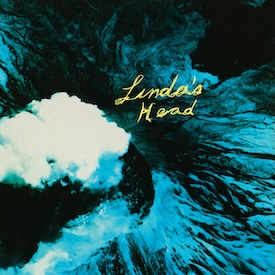 There are only a few artists you can point to as having directly shaped this century’s musical and aesthetic underground (and mainstream-trickling) trends; Liz Harris AKA Grouper is one of them. Sure, there is a long tradition of lone, reclusive weirdos making unconventional noise, but her gorgeous, working-class, wilderness-isolated, hunting-cap-and-hoodie, vaguely occult and emotionally distant style remains distinct, even as hordes of wannabes do their best to co-opt it. I’ll cop to being slightly late to accept that there can be a modern classic album with the title Dragging A Dead Deer Up A Hill, but I’m here now, savoring the way her wraithlike pianos and century-old guitars emanate rich and offbeat melodies, lodged in our brains right next to the ticks we picked up while camping. Helen is her quote-unquote rock band, a compact trio featuring record-digging genius Jed Bindeman on drums and Scott Simmons (of Eat Skull and The Lavender Flu!) on bass. I was as primed to love Linda’s Head, the group’s first record in a decade, as you are, but it’s falling flat on my ears, like a camping tent that refuses to be assembled. I appreciate that the gaseous reverb of Grouper follows Harris into all of her work like a protective cloud, but these songs can’t punch their way out of it, nor do they try. Bindeman’s dishing out lively variations on indie-rock drum rhythms, and Harris’s voice can never not sound like an angel buried in the leaves, but the songs here offer little to grasp or appreciate. I’m reminded of (the not that great) Crystal Stilts, a live fan-shot Instagram Reel of Nothing, or those earliest Dum Dum Girls demo recordings, but all of those acts aspired to something greater. Helen seems to expect that their audience will do all the heavy lifting, to listen with the utmost attention required to commit these bland songs to memory, lest they be forgotten as quickly as they arrived.
Little Gold Public Dog LP (Tall Texan)
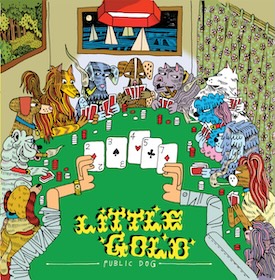 All across the land, pop-punk hearts are beating under the Carhartt hoodies of guys bringing John Prine and Blaze Foley records up to the counter… we simply have to accept this. If it’s not already your vibe, I can understand the hesitation to acknowledge it, but I’m not scared. There are like three generations of Americans raised on pop-punk now, many of whom went on to far more interesting creative pursuits; I’m more suspicious of anyone who pretends Dookie isn’t one of the all-time greats, to be honest. Little Gold has been Christian DeRoeck’s prime pursuit since 2011, though you may recognize him from scruffy Brooklyn underachievers Meneguar. The man clearly believes in the power of the song, and he’s been honing his chops not for the glory, but out of pure love of the game. Little Gold lubricates the timing belt of Americana with power-pop grease until the engine purrs, and with Public Dog they inch closer to the sublime. The music jangles like Teenage Fanclub and sways like Chamberlain, a ’90s power-pop sound embellished with the fireside glow of Fender Rhodes and the amber waves of pedal steel. DeRoeck takes some bold lyrical swings over these tender and confident instrumentals, the biggest being “Early Internet”. It’s incredibly difficult to incorporate the world wide web into one’s balladry, but DeRoeck goes for broke and nails it, opening with “Hippies hate water, or so I’m told / on a mixtape I received when I was twelve years old / from a girl I met on Prodigy” and rolls from there as I nod along in shared nostalgia. It breaks my heart that Zoomers will never know an earnest, lawless internet where curiosity and connection were rewarded, but we don’t all have to shoot a man in Reno to appreciate Johnny Cash – that’s the beauty of a good song.
Finn Loxbo Lummernikt LP (Fönstret)
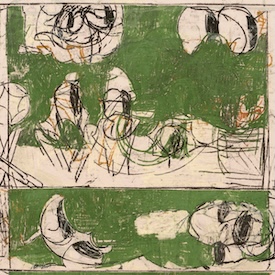 On his 2018 collaborative LP with Karin Johansson (reviewed in these very pages!), Finn Loxbo pecked at a variety of instruments from unorthodox angles, resulting in a world of curious, fragile sounds not unlike AMM or MEV. On Lummernikt, Loxbo is on his own, and my god, he sounds like he just escaped from jail or narrowly avoided being struck by a commuter train or some other sort of “new lease on life” situation. Loxbo expresses this sense of unbridled enthusiasm with his acoustic guitar, a defiant melodic logic performed virtuosically and bursting with light. His style reminds me of Hans Reichel in particular, whose works on acoustic guitar (and a self-designed “daxophone”) dazzle with intricate labyrinths of notes miles from E standard tuning. I’ve been slowly gobbling up the Reichel albums I don’t already have whenever an extra fifty bucks lands in my wallet, but I’m going to pause on that in favor of spending extended time with Lummernikt. Loxbo’s fretwork is exquisite and in sharp focus, as the multitude of single, muted notes soar like ocean spray… imagine if Bill Orcutt applied his meanest fingerpicking techniques to the task of making an acoustic guitar record for getting fussy babies to sleep. It’s an undeniably technical feat, but Loxbo’s music is emotionally expressive too, particularly if you’re prone to joy or wonder in spite of our current circumstances. I find it difficult to be entirely pessimistic knowing some Swedish guy my age made Lummernikt and shared its beauty with the world.
Paper Pools Everything LP (Paper Pools)
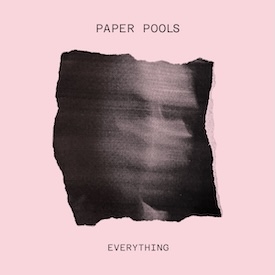 One thing about private press albums from the ’70s and ’80s is that they weren’t trying to be “private press”. Those artists were determined to make it even if the industry extended no support, even if their image was commercially unviable, even if the trends were unaccommodating to what they had to offer. Looking at it that way, Everything by Paper Pools, the work of “artist, producer and designer Allen Orr”, is a modern-day heir to the private press era. For one thing, this is indeed a DIY affair, self-released by Orr (and hand-numbered on the back cover!). For another, he’s clearly shooting for the stars with it. Bringing in the well-respected Dave Cooley to master the album and the Grammy-winning Shawn Everett to mix the title track, Paper Pools is targeting the modern indie charts with unabashed intention. It’s not a style that comes through these pages often, this male-forward alt-pop approach in the realm of Twenty One Pilots, Washed Out, Cut Copy, Phoenix, Cigarettes After Sex, or basically any of those groups in small-medium fonts on a big IHeartRadio summer festival poster that merges alt-rock and pop and techno that you, dear YGR reader, will never, ever bother to check out. But Paper Pools is going for it, and I wonder if he might get any digital playlist traction and see some of that success, or if his music is a little too smart, artful, and lacking the dumbed-down pop-hits of Cage The Elephant or Portugal The Man or one of those other bands we’ve never – and I cannot stress this enough, ever – in our right minds listened to.
RAP Navigator LP (Jolly Discs)
 About a month ago an album by a band called Jazz was reviewed in these pages, and now here’s RAP. It’s kind of stupid, isn’t it? All is forgiven for the London-centered duo of Guy Gormley and Thomas Bush, however, as Navigator is a brand new spin on some unlikely aesthetic bedfellows. There’s a lot to dig into in this album, but on a whole, I ask you to picture the most melancholy, old-school, Screwed Up-style g-funk instrumentals – I’m talking Pimp C, Mass 187, Fat Pat – paired with elder British schoolboys singing with their Sunday mass voices. Sometimes they don’t sing at all: “Counterstrike”, for example, sound like an instrumental deleted from Too Short’s Cocktails album because he couldn’t make it out of the vocal booth without crying. It’s a crazy combination on paper, this union of slow-rolling rap instrumentals and twee-pop vocals, but it coalesces here as strikingly as Ice Cube in a Raiders hat eating jellied eel. The album reminds me of how John T. Gast is able to synthesize modern humdrum city life into novel new sonic formulations, because RAP aren’t merely combining two contrasting styles, they’re articulating their own unique vision in the process. “Wannabe”, “100 Pounds” and “Barley Wine” are particularly mesmerizing, like a mid-’80s Rough Trade boy band reimagined by China Miéville for one of his darkly speculative and unwaveringly British sci-fi realms. Recommended!
Rat Cage Not Asking For Much LP (La Vida Es Un Mus)
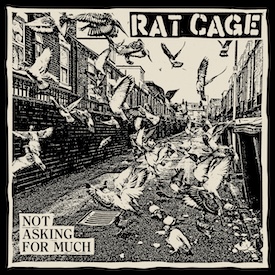 Rat Cage is one of those modern punk entities where the recordings are the work of one person (in this case, Bry Suddaby), but they also play shows with people who I guess aren’t technically part of the band? It’s confusing, but maybe you’re not supposed to really think about this stuff, not when the music is as gloriously raging and absorbing as Not Asking For Much. It’s my first time really checking out this celebrated British act, and as suspicious as I am of studio hardcore, there’s no denying a grade-A ripper when I hear one. It’s also refreshing that Rat Cage doesn’t sound like everyone else, nor do they shoehorn an incongruous mix of styles together in an attempt at innovation. What they do instead is put together dynamic, anthemic songs with angry choruses ready to burrow into your skull, immune from trends, novelty or the passage of time. Weirdly enough I’m reminded of certain unfashionable spiky punk bands of the ’80s, ’90s and ’00s – specifically Violent Society, The Varukers, The Pist and Germ Attak – in the way that those bands kept the crowd engaged with gang-vocal choruses, memorable songs and the sense that they really put their lives into their music. The added benefit of Rat Cage is that they replace the thin, trebly sound (and uncomfortably close proximity to the Epi-Fat style) of the ’90s with the formative hardcore heft now understood as the cream of the crop: Poison Idea, The Fix, Anti Cimex and Death Side all echo through this bruising album. I don’t care if Rat Cage is the work of one anti-social individual or an oath-sworn gang – Not Asking For Much is some of the most replayable, compelling hardcore-punk I’ve heard this year.
Sleep D & Mosam Howieson Syphon Filter 12″ (Butter Sessions)
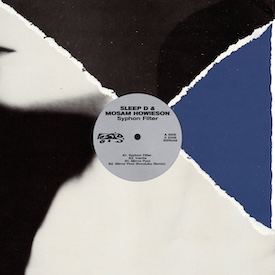 Another year, another failure to attend (and thus transcend) at the Making Time electronic dance music festival that takes place less than five miles from my home. I’m left to salve this psychic wound with the sort of soul-bending techno I missed out on, this new collaborative EP from Melbourne artists Sleep D and Mosam Howieson being a sensible makeshift remedy. Sleep D has been firing off ecstatic hard-rave missiles for over a decade with no signs of stopping, and while I wasn’t yet familiar with Howieson, I trust the duo to only work with other folks on their advanced level. That trust is supported by “Syphon Filter”, a hectic sonar warning system that vibrates my spinal column like a tuning fork, and “Inertia”, whose calming presence feels like I’m playing a bird-watching video game for Nintendo 64 (imagine it: the worst Christmas present of 1997). “Mirror Pool” honors its title with a plane’s eye view of crystal lakes at sunset, shimmering in oranges and pinks. We even get Dutch producer Konduku’s take on “Mirror Pool” to close the EP, a bout of patient refraction that spends more time teasing the beat than delivering it. I’m mostly here for the sparkly obliteration of those first two tracks though, as Sleep D and Howieson pack these cuts with the hectic activity of organic life, relentless but ever-shifting. No more excuses: 2027 is my Making Time year!
Spring Breeding Backflip Soundtrack 10″ (Zum)
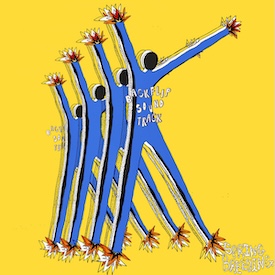 They opened up a time portal to 2003 and disguised it as a ten-inch EP by a band called Spring Breeding! I’m really kinda blown away by Backflip Soundtrack, in that it soundtracks not only backflips but the hyper-specific neon noise underground of the early aughts as well, one in which I directly participated and fondly recall. What’s particularly wild is that the Zum record label was fully active in that era of American Apparel short-shorts and spray painted CD-rs, releasing music by fringe punks like Out Hud and Total Shutdown long ago. Now all these years later, they’re promoting the contemporary and youthful Spring Breeding, whose spastic DIY keyboard music could’ve been a Total Shutdown side-project had it existed a couple decades earlier. The trio’s cheapo synth pre-sets recall the Nintendo-core of Neon Hunk, Numbers and Oh No The Modulator, whereas their fall-on-the-floor presentation is all XBXRX, The Book Of Dead Names and -tion. There was a time when Wolf Eyes and screamo uncomfortably co-existed (right as Friends Forever were performing guerilla-style in their van), and I’m glad to hear the youth replicating these passionately ratchet sounds; sassy freakouts with white belts cutting off blood flow the same as they ever did. The important thing is that there’s no path for a financially solvent corporate market to bleed capital out of Spring Breeding – so long as they’re playing “Backflip Soundtrack” and “In The Cockpit Of My Mega Mech”, we’re safe.
Truck Violence The Weathervane Is My Body LP (The Flenser)
 Been seeing Truck Violence t-shirts on some of the more disgruntled-looking teens at hardcore shows over the past few months, and it piqued my interest: band or Xbox game? While I’d love to play a round of Truck Violence at Dave & Buster’s someday, for now it’s simply a band, from Montreal in fact, whose 2024 debut cassette garnered a 2025 re-release on Southern Lord. Their new album, The Weathervane Is My Body, is out care of The Flenser, a label that has been sucking up much of the underground-metal oxygen lately thanks to marquee acts like Agriculture and Chat Pile. Perhaps I’m either way too deep or not nearly deep enough into this particular scene, but my reaction to The Weathervane Is My Body, besides my appreciation of its captivating cover image, was immediate and decisive: what a flagrant Chat Pile rip! The groaning guitar chords that resonate with GY!BE-style desolation theatrics; the hefty, down-tuned, Munky-esque swing; the dramatized anomie, with lyrical imagery of men struggling and reckoning with the abjection and disparity of modern society; the drowsy acoustic ditties to buffer the metallic dirges; the vocals swinging between throat-shredding screaming, wounded-dog yowling and quietly confused emotional-breakdown muttering… all these similarities can’t be entirely accidental, can they? There are sonic differences of course: Truck Violence gaze deeply into emo’s twinkling eyes, and they prioritize the banjo as a conjurer of darkness (similar in that way to prior tour-mates Show Me The Body), for a fairly visceral and complex sound. I acknowledge that there are lots of bands, past and present, who artistically combine the darks of hardcore, metal and noise-rock with the lights of ambient, shoegaze and folk. Similarities are bound to occur, intentionally or otherwise, but the mirror that Truck Violence holds up to their label-peers dominates my view.
The Wolfgang Press Asylum Variations LP (Downwards)
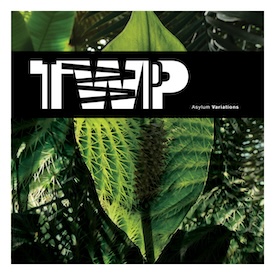 The ability to append “ex-Rema Rema” to your band name is one of the highest forms of post-punk cred, but 4AD day-ones The Wolfgang Press aren’t relying on outdated bonafides. They took nearly thirty years off following their initial run, dropping the ingenious A 2nd Shape in the final hours of 2024 (and immediately rendering my year-end best-of list inaccurate); Asylum Variations continues in similarly spirited fashion. If you haven’t heard any Wolfgang Press, I strongly urge you to stop what you’re doing and fire up A 2nd Shape after four cognacs, but Asylum Variations is a fine place to start as well, a continuation of their slow-paced, queasy pop constructions, handfuls of unidentified pills swallowed without a second thought. Vocalist (keyboardist / bassist) Michael Allen is the star of the show, warbling like Brother JT and Nick Cave over vivid and disorienting synth-wave vignettes. Imagine if Cave and company used Grinderman as an opportunity to emulate Cabaret Voltaire rather than Junior Kimbrough, with the same outrageous looseness and wicked sense of fun, and you’ve got an idea of the playful menace behind these recent Wolfgang Press albums. You almost have to reach that irrelevant middle age to be able to write as freely and creatively as songs like “The Art Of Writing” (a trashy, black-lit distortion) and “Sail By” (woozy crooner sleaze), and I’m so glad these guys are doing it. In a metropolis of black-on-black pre-fab synth wave assembly, The Wolfgang Press are a flashing neon sign with an arrow pointing toward the vault around the corner. Meet you there?
 Their bio still reads Northampton, MA, but Boy Harsher have gone fully Los Angeles in every other way. With a fresh major label contract (they still make those?), film and television syncs all across the Hot Topic t-shirt wall from Chucky to Terrifier 2, a 2024 Coachella appearance, their own erotic-horror movie A Lonely Woman (starring Chloë Sevigny, FKA twigs and Sturgill Simpson!), and top placement on every wannabe health-goth’s playlist from Violet Chachki to Kendall Jenner, I’m a little shocked that they appear to mostly have the same faces in their new promo photos as they did two years ago – maybe they were waiting for the Atlantic check to clear before calling Dr. Paul Nassif. Whatever the case, it’s been quite a while since Boy Harsher hit us with any new actual club bangers. 2019’s Careful was more sensual atmosphere than pop functionality, and I started to wonder if they weren’t quietly transitioning from a band into a music supervisor firm / merchandising company hybrid. Get Mean sets that record straight by aiming straight for the dance-floor and delivering the goods: twelve compact, ready-to-wear cuts of mercilessly sexy, retro-’80s dark-wave. It’s what made us fall in love with them to begin with – Boy Harsher remain the best modern interpreters of “Blue Monday”, “Enjoy The Silence” and “Tainted Love” – and they remind us that they have yet to be dethroned through catchy new morsels like “Jeans”, “Tough Luck (When You Don’t Call)” and “Hard Beat”, alongside slight formulaic diversions such as “Bleed”, whose rock-bottom anguish calls to mind November Növelet, and the Daughn Gibson-esque “Pray 4 Me”. If you had any inkling to enjoy their music in the past, the designer leather gloves of Get Mean will pull you right back onto the dance floor.
 Leave it to the Cruelster Extended Universe to charm us with an origin story of “We started this other band when one of our bandmates was late to practice”. At least that’s my understanding of how The Carp got started, the Cruelster-related band voted Most Likely To Shave Its Head. Cruelster’s Make Them Wonder Why from last year still has me wondering why, but in the meantime Tangled Up With The Two Tailed Rat is a pleasant addition to this crew’s ever-expanding catalog. Nate Ward’s vocals stick out like they always do, though the songs are less hardcore, more poppy street-punk-inspired, suitable for filing somewhere between Vulture Rock and Taang!. If one of these guys’ bands ended up on a Give ‘Em The Boot comp, it’d be The Carp, and they’d be thrilled! Sure it’s a little silly, just like everything these guys touch, but also really good. (Being great bands also seems to be part of their joke.) The hooks have plenty of time to shine in these punchy mid-tempo rhythms – you’ll be raising fists to “Fuck Alex Karp” and skanking with your two-toned sweetie to “I Crave The City”. With the way we’re siloed out now, it seems unlikely that Tangled Up will reach many audiences beyond Total Punk’s underground bonafides, which is a shame because there’s clearly a large swath of youth (I’m talking real live teenagers) paying to see Black Flag, Circle Jerks and Dead Kennedys when they would be much better served by The Carp, whose punk rock is fully primed for rowdy, wise-assed fun.
  Convincing evidence that all the great band names haven’t already been taken! London’s Curbside Lambsear falls on the right side of twee, ready to mix it up with the rest of London’s art-minded, post-post-punk milieu. Ex-pat Austrians Magdalena McLean and Annabelle Mödlinger have been busy with their respective musical pursuits caroline and The Umlauts, but I’d love if they focused on Curbside Lambsear for a while, as the results of this initial session are compelling and cool indeed. It’s incredibly easy to enjoy this debut five-track EP, each song markedly different from the next. Opener “No Ordinary Word” is part Dry Cleaning / part Bark Psychosis, though the exquisite violin (McLean’s primary instrument) leaves me feeling like Moin just remixed Dirty Three. “Jjochstubn” swings quite slower, vocals effects-pedal-warbled like early Duster for six minutes of ash-in-the-air hypnosis. “Man The Door” is a lattice of pretty jangle, delivered within a DAW-crafted facsimile of reality. I’ll do the last two tracks too! “Avril” sounds like a measured European response to what Kim Gordon’s been up to lately, and “Uneasy” finishes with a seductive glitch and manic, out-of-nowhere drums. True to its namesake, Put Rings On All My Fingers To Weigh Down My Hands is a cozy nook, soft to the touch as it blooms beside a functional concrete form.
 Detroit tech-house wunderkind turned homesteading family man Matthew Dear has graced us with some real gems through the years. My personal favorites include the sweat-soaked techno erotica of his Audion alias (that Suckfish album!) and the sultry dance-pop of Black City (my 2010 album of the year, a designation that probably still holds true). Dear’s output in the 2020s has been scarce, however; a seven-inch for the French Salon Records label is clearly not a publicist-savvy, algorithm-grabbing maneuver, which endears me towards him even further. I got a little worried when he started dabbling with generative AI “art” a couple years ago (it seems we all have a friend like this), but fear not – this new single is an outstanding treat for those who catch notice. “New Drug” takes a Perlon-esque minimal-techno compulsion and relaxes it into a self-assured saunter. It’d be a barrel of fun as an instrumental, but Dear shines it into a future-pop gem with his uniquely weary multi-tracked vocal. Overtly digitized and compressed, Dear sounds like an old wizard trapped inside a dying GameBoy Advance, and when the astringent synth leads add a touch of melody a couple of minutes in, I’m starting to wonder if he isn’t our generation’s Martin Rev. Glorious! On the flip, “Head In The Clouds” is a gentle come down, an instrumental nu-disco loop ala The Field accessible for any engaged dance crowd. “New Drug”, though, goddamn – let’s hope this is a sign of Dear to come.
 On the insert’s photo montage, there it is: an illuminated marquee confirming that Gapeseed once had the honor of opening for Foreskin 500. Tell your grandkids! Below it, a different photo shows a stack of cardboard boxes with “GRAPESEED CD’s” written on them, which attentive readers will notice is not the name of the band. Such were the silly indignities of playing indie-rock in the ’90s, the era in which Manhattan’s Gapeseed bounced around. Lo Cell was originally released on the dignified compact disc format in 1994 by Silver Girl, and with the label recently reanimated, now it’s on vinyl, too. Gapeseed were clearly not a band that could be your life, but I appreciate the unheralded role of fameless, fortuneless first-wave indie-rock bands that kept used CD stores afloat with their individual spins on underground guitar music. You can tell that Gapeseed were moved by peers like Sonic Youth, Sebadoh, and The Flaming Lips, and who can blame them? Their hook-averse, experimental-dabbling nature sounds as fresh here as our current wave of like-minded artists, though the use of walkie-talkies and vibrating pagers on guitar pickups in “Watermelon Bread” was comfortingly of its time. Maybe I shouldn’t put it out into the universe that Foreskin 500 have yet to reunite following their 1997 break-up, but if they were to, can you think of a better opening act?
 Glory be! Boston’s Intensive Care Unit finally grace us with their first widely-available slab of vinyl, following a comedy of lathe-cuts, tapes and rejected test pressings (upon rejected test pressings). This is hardcore in its purest, noblest form, as if dictated verbatim from The Book of Tony Molina. Self-released vinyl with a modest digital presence that you’ll have to seek out on your own, no multitude of deluxe “colorway” editions, no front-facing promotional videos where the band members are forced to rank their top five favorite shoegaze albums, none of this un-punk crap we’ve all passively accepted as “the way things have to be done”. Instead, ICU delivers a fourteen-song(!) seven-inch EP with Letraset fonts, a couple different folded inserts and all the requisite hockey imagery you’d want out of a Boston hardcore EP. It’s in their sound, too – ICU sounds like Negative FX covering Siege, short shocking bursts of fast-beats / blast-beats with Ban Reilly’s vocals providing the creatine to their meat-based purée. Reilly sang for Boston Strangler, of course, who were basically the Turnstile of 2012 (you know, before YouTube taught an entire generation of kids how to incorrectly mosh). Let’s hope some of those kids are paying attention to ICU instead, so that the flames of genuine, unadulterated hardcore-punk might continue to burn unabated.
 Let’s not leave Perth out of the Australian indie-punk conversation, however geographically isolated it may be. I’m forever in that city’s debt for both The Victims and The Scientists (and, alright, Extortion too), and I suppose I should find some space in my heart for Moya Moya as well. They’re described as an “art-punk” band, though it would seem that their preferred artistic mediums are improv theater, comedic writing and surreal sketch comedy: you know, the nerd’s domain. Over forceful indie-pop and anxious post-punk melodies, the lead vocalist – I’m not sure if it’s guitarist Liam MacFarlane or bassist Jaydn Kempe – rants and squeals in an overly-affected tone. Seeing as many of the lyrics are delivered sarcastically, this exaggerated vocal style helps ensure there is no misinterpreting the sentiment behind “Habitat”‘s opening line, “Who gives a fuck about destruction of habitat”. It’s far from my favorite vocal delivery – this loony, vibrato-dipping characterization that falls somewhere between Jello Biafra, Vintage Crop’s Jack Cherry and (gulp) Geordie Greep – but I suppose in this era of bad faith misunderstandings, it’s wise to exercise caution when conveying your strongly-worded sentiments. I’m certain that I fall on the same side of the political fence as Moya Moya when it comes to racism (“Wacist”), the environment (“Habitat”, “…Aramup”), and class (“Holiday Home Pt. 1”), so cheers to solidarity… I’d just rather hear these clever lyrics gargled by the caustic throat of Extortion’s Rohan Harrison.
 Starting to worry about the youth… do they really not know how many digits are in a phone number? I guess since our “phones” are primarily synthetic dopamine replacement devices occasionally used to ignore spam calls, this societal loss was inevitable. Sydney’s Michael Barker is the one responsible for this 1-800-MIKEY alias, and I’m not gonna be too tough on him, because really, it’s not like we want PhDs writing our poppy punk rock, do we? Dee Dee Ramone could barely spell “Dee Dee” and yet we love him dearly. As a punk rocker, Barker gets most of his knuckleheaded kicks in the band Gee Tee, one of Australia’s finest egg-punk exports, but as 1-800-MIKEY we witness his softer side – Barker’s Anime cartoon rendering on the cover is apt. This is cute, chorus-driven power-pop in the modern underground style, proudly demo tape fidelity with big-swinging guitar moves and saccharine, gentle vocals. The melodic hooks are tender in a Raspberries sorta way, performed with the urgency of punk rock and bedroom-rockstar grandeur – I can picture Barker on his bed, high-kicking like David Lee Roth to an audience of stuffed animals. The feel-good, Sheer Mag-esque guitar leads are a satisfying touch, and Barker’s emerging songwriting craft is evident, though the finished product hasn’t totally drawn me into its private chatroom. There’s a good chance this particular aesthetic strain of power-pop simply isn’t meant for me, though – I’m one of those dinosaurs who prefers texting words over emojis.
 Dub remains a fertile and vital medium for outsider viewpoints, restricted only by the creative limits we impose upon ourselves. I thought the finest Japanese dub music I’d hear all year was Mermaid’s latest full-length, but this album from 7FO, while drastically different in sound and aesthetic, deserves strong consideration. ひろった石が割れた is my first encounter with the Osaka-based producer, and I see I have a big pile of older stuff to check out, leaving me curious to understand if this album is an outlier or if previous fans knew what they were in for. Let’s see if I can explain: 7FO’s sound spectrum is scruffy and patinated, the digital dubs of the 1980s mixed with an imagined digital dub sound of generations long past. Dusty organs wheeze and cough in half-time skanks as traditional Japanese melodies and old-timey bells and whistles spurt and fade like the sooty toots of a coal engine. It’s really great! I’d like to send you to “Madoromi (まどろみ)” in particular, a prime example of 7FO’s unique approach – I’m hearing a ghost-ship docked at Kingston Harbor with a bunch of formal-wear dignitaries slow-dancing in the faded ballroom, oblivious to the fact that they drowned a century ago. “Haunting” tends to imply spooky minor-chords and anxious fright, but 7FO’s ghosts are cordial and amused, maybe even a little inebriated. If it turns out the soaked strings and deformed bass of “Dōgubako (道具箱)” is already a signature 7FO technique, no more messing around – I’ve got to buy all five previous 7FO albums at once.
 Right as we were running low, Feel It’s squeakiest post-punkers return with a third installment of joy. There’s no shortage of extremely extroverted singers on the Feel It roster, but Briana Hernandez might be the kookiest of them all. For one thing, she never shuts up, and secondly, she sings her lines like a drunken Mary Poppins, her loopy melodies rising and falling so rapidly that weak-stomached listeners may want to pop some precautionary dramamine. It’s one of those potential dealbreakers, so overpowering is her personality, but I’m here for it – why sing in a band if you want to pretend like you’re not interested in singing in a band? If you can make it through the sped-up chaos her vocals bring to the conclusion of opening cut “Abolish Chance” without flinching, I want to welcome you to the club. The boys of Spread Joy give Hernandez plenty of taut n’ funky music to wildly enunciate over, a twice-as-fast Parquet Courts raised on B-52s music videos, now well-versed in all those 99 Records classics. Spread Joy love to dance, but “Pygmalion” skips to egg-punk’s lou with the best of ’em. If the Chi Peps were forced to donate “Give It Away” to another band due to an actuarial error caused by the sale of their catalog, I know who I’m nominating…
 Katy Otto should be a familiar name for anyone who ever thumbed a coffee-stained copy of HeartattaCk on a dumpstered porch-couch while waiting for the potluck vegan stew to heat up for the touring band who just arrived off a twelve-hour drive from Arkansas or Saskatchewan to perform for a basement audience of fifteen. She’s been in tons of bands across multiple decades now, and has been running the Exotic Fever for essentially as long. Otto gets to enjoy both with Sun Within, her newest trio. The trends may change but Otto’s tastes haven’t – Sun Within perform emo-grunge in an authentically late ’90s way, far from the pernicious grasp of corporate tentacles. “Luminous Events” is part Hole, part Spitboy, though they’re mature enough to realize how to temper those wildfires accordingly. I hear the same thing in “Synthesis + Realization”, and wish there was a third or fourth song to see how long they keep it up. Sun Within finally release the tension with the b-side’s backing-vocal-chanted chorus, a punk alley at the intersection of Lungfish, L7 and Major Stars. With even the smallest bands behaving like desperate commercial brands, lots of listeners are pushing back against it in search of something real and roots-oriented, so I ask, which of these ethical touring bands is going to pay Sun Within a fair wage to open a tour for them? Sun Within already know what that vegan stew tastes like… they probably even enjoy it.
  Let this be my first encounter with Cudighi Records but not my last! There aren’t many labels as likely to release Dan Melchior and Little Wings as left-field Finnish electronica; keeping track of the few that exist seems like a suitable purpose for my quaint little life. Otto Taimela is a Finnish producer with a whole lot of production credits over the past eight years, most recently to include Cheap Ingredients. If you’re at all tapped into the Warp / Planet Mu electronic-music expanse, you’ve heard sounds like Taimela’s before, but that doesn’t make the experience of Cheap Ingredients any less pleasant. Much like Aphex Twin, Taimela engineers multi-layered beats and protects them in cushiony bass and sugar-crusted chords – imagine a sharp-edged robotic skeleton surrounded by a thick outer layer of marshmallow. There’s probably a Pokémon that looks exactly like the creature I’m imagining when Taimela’s wriggly techno constructions appear: big round booty, smiling duck-bill, adorable little T-Rex arms. Break-beats and four-on-the-floor techno thumps are equally time-tested and Taimela is no stranger to either. In “New Life”, you get a taste of both, a fluttering trance experience ready for your next Kawaii-themed rave. Can we get a Dan Melchior remix next time?
 Shoutout to Glenn Donaldson’s blog for tipping me (and now us) off to this exquisite pop charmer from Al Montfort and Amy Hill (aliases Sleeper and Snake), whose names you might recall from Total Control, UV Race, Constant Mongrel, Primo!, Terry… the list continues to gloriously unfold. Here they’re linking up with Stephanie Hughes (of Dick Diver, Boomgates, et al), and as such, a comprehensive heap of top-notch Aussie underground sounds are already tucked under The Truffle Pigs’ collective belts. Where do they go from here? Why, they dial it down and pull you in close with some charming, acoustic-driven ditties. I’m reminded of those early post-punk acts who wanted to flip the ideas of their favorite ’70s folk artists into something they could call their own: Tall Dwarfs, Felt, Swell Maps and The Kiwi Animal all come to mind. Unlike many of the records that pass through these pages, though, Lanes And Lanes And Lanes doesn’t seem to aim for a specific historic era so much as it’s alive here and now. These are old, trusty tools used by wise craftspeople to express themselves in the present moment. You’ll sway to “That Can’t Be Right” and “Celine” like you do with your favorite Mojave 3 songs after you check the credits of “Wild Rose” to see if Townes Van Zandt wrote it (he did not). These three are DIY pros, whose most oddball inventions (“73339”) compliment their most refined (“Insane Pics”). Thirty-six bucks for Australian shipping is never pleasant, but in situations like these, I don’t see any other reasonable choice.
 This fantastic Welsh quartet makes a hard life sound easy… downright seductive, in fact! Hard Life is The Tubs’ third full-length (and first for big American indie Merge), and if they aren’t feeling smugly proud of themselves for delivering such an eye-wateringly beautiful album, that just shows what a class act they are. If you aren’t already a fan, this is the perfect time to get on board, as The Tubs have never sounded better, equal parts The Jam, The Housemartins and The Gin Blossoms. Frontman Owen Williams continues to wield one of the most distinctive voices in modern indie-rock, forthright and vulnerable and capable of twisting a single syllable into a melismatic heart-punch. Williams has also mastered the ability to sound extremely happy and sad at the same time, and he uses that skill to devastating effect on the first five songs here, an impeccable run of Northern soon-to-be classics. If you ever wished you could dance and sing along to the Friends theme without tarnishing your social reputation, I offer you “Stoop To Me”; “Who’s Gonna Love You Now?” is the song that Cameron Crowe could base the entirety of a modern Singles reboot around. (The boy works at Cafe Oto, the girl works at Rough Trade… can their budding romance survive??) And did I mention there’s pitch-perfect use of Chris Haigh’s fiddle throughout? Whatever your current ailment, I’m certain that Hard Life is the appropriate remedy.
  Roughly one year after their debut EP, Cleveland’s Xanny Stars offer up four more grunged-out pop-punk noogies. I’m kind of starting to like the fact that most record shops don’t acknowledge the existence of new seven-inches, or have a reasonable place to put them – at least ones that aren’t accidentally-ordered Record Store Day rubbish – as the format itself is quietly reverting to a true underground status. As it should be! It sucks that they’re no longer five bucks postage-paid, but the same could be said for literally any other physical commodity (I say it on a daily basis in fact), and if you’re going to splurge on a vinyl record, why not go for the DIY appeal of Xanny Stars? They nail that regional pop-punk sweet spot, ready to light up the local VFW hall after loitering the hell out of a Speedway parking lot. Much like their debut EP, I’m hearing similarities to Jobber, Screeching Weasel and The Muffs, albeit on an unsigned scale. By the time “See Right Through” hits, I find myself transported to a suburban supermarket loading dock, wearing a Big Drill Car t-shirt and a Sinkhole hoodie, drinking a gallon of Rosenberger’s iced tea while attempting to land a solitary kickflip. Xanny Stars didn’t intend to send me into a nostalgic seizure, but what’s the harm in putting a smile on a sad old man’s face, one last time?
 Back to top